AI agent development services
AI agent development: agents that take real actions, and ask before risky ones
An AI agent does more than answer. It calls your APIs, updates records, triggers workflows and reports back. The hard part is not getting a model to call a tool; it is making the agent reliable, auditable and safe enough to let near real data.
I build tool-calling agents and agent platforms in production: Stackboard's board agent plans changes and waits for confirmation, AgentLoom runs multi-step agent workflows with MCP tools and durable execution, and Echo Prompter runs agents in parallel for 10–100× faster prompt processing.
Problems I solve
Agents that act without asking
Deleting records or sending messages on a guess is unacceptable. I add review steps: plans the user approves, thresholds for bulk changes, and expiry on stale plans.
Unreliable multi-step runs
Long agent runs time out or fail halfway. Durable execution resumes from the failed step with retries instead of starting over.
Models doing maths and dates badly
Language models get arithmetic and weekday calculations wrong surprisingly often. I move that logic into code tools the agent calls.
No record of what the AI did
Every action an agent takes should be logged with the prompt that caused it, so you can audit, debug and roll back.
What I build
- Tool-calling agents
- OpenAI, Claude or Gemini function calling against your APIs, with strict schemas validated by Pydantic or Zod.
- MCP servers and clients
- Model Context Protocol servers that expose your tools and data once, usable from Claude, Cursor and custom agents, with network guardrails.
- Human-in-the-loop controls
- Reviewable plans with per-action approval, confidence thresholds and escalation to a person when the agent is unsure.
- Workflow orchestration
- n8n or Inngest workflows with retries, scheduling, webhooks and cron triggers around the agent.
- Parallel execution
- Agent pools that run many prompts or tasks at once, with rate limiting and cost tracking per run.
- Audit trail and evaluation
- Every tool call logged with its prompt and result, plus regression tests that catch behaviour drift when prompts or models change.
Related work
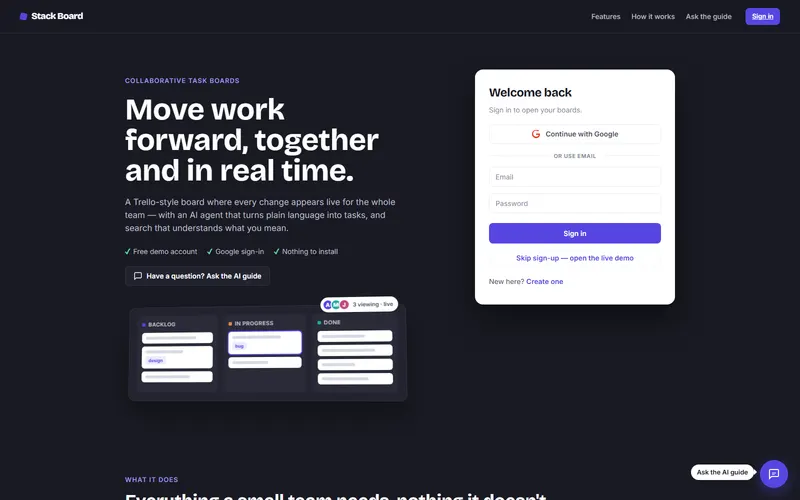
Real-time task board with an AI agent
Stackboard
A real-time collaborative task board with an AI agent that plans changes and asks before it applies anything.
Read the case study →
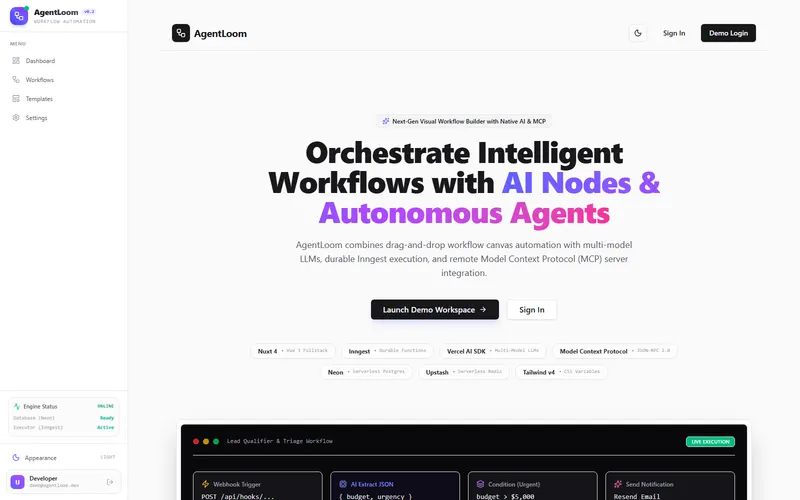
Visual AI workflow automation with MCP
AgentLoom
A visual builder for AI workflows with durable execution, multi-model LLMs and native Model Context Protocol tools.
Read the case study →
- echo-prompter
Parallel-agent AI prompt automation platform
Echo Prompter
An enterprise platform that runs prompts 10–100× faster with parallel agents, and regression-tests AI output for drift and hallucinations.
Read the case study →
How we'll work
Step 1
Map the actions
List exactly what the agent may do, what it must never do, and which actions need human approval.
Step 2
Build the tools first
Deterministic, tested tools for every action and calculation, so the model only decides which tool to use.
Step 3
Add the agent loop
Planning, tool calls, confirmation steps and streaming replies, tested against real scenarios.
Step 4
Harden for production
Rate limits, retries, durable execution, audit logs, cost tracking and regression tests.
Technology
- OpenAI function calling
- Claude
- Gemini
- MCP
- Vercel AI SDK
- LangChain
- Inngest
- n8n
- Python
- FastAPI
- .NET
- Node.js
- Redis
Frequently asked questions
What is the difference between an AI agent and a chatbot?
A chatbot answers questions. An agent can also act: it calls tools and APIs to create, update or trigger things in your systems, then reports what it did.
How do you stop an agent from doing something harmful?
Agents only get the tools you approve, risky actions return a plan for human confirmation, plans expire and are re-checked before running, and every action is logged.
What is MCP and do I need it?
The Model Context Protocol is an open standard for exposing tools and data to AI models. If you want the same tools available in Claude, Cursor and your own agents, an MCP server lets you build them once.
Can you integrate an agent with our existing systems?
Yes. Agents call your REST or GraphQL APIs, databases or internal services through tools with strict schemas. I have integrated with .NET, Java, Python and Node.js backends.
How long does it take to build an AI agent?
It depends on how many tools and systems are involved. I scope it after a discovery call and send a fixed-scope proposal with milestones and weekly demos.
Tell me what you're building
A short description of the problem and your data is enough. I'll reply with questions and a time for a call.
Start a project