Multi-vendor appointment marketplace
Slotly
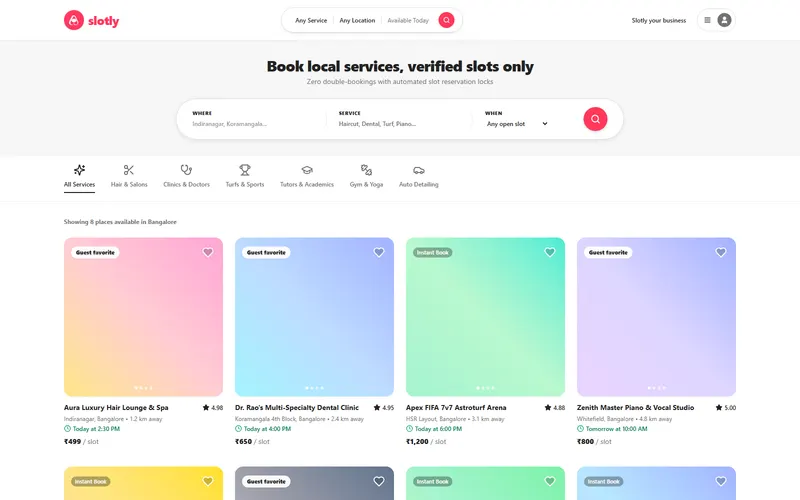
A booking marketplace for salons, clinics and consultants where the database itself makes double-booking impossible.
My role: Design and full-stack development across a Turborepo monorepo
- SaaS
- Next.js 15
- Drizzle
- Neon
- Razorpay
Overview
Slotly (formerly BookEasy) solves high-friction local service booking. It bridges walk-ins, online payments and staff shifts with a hard guarantee against overbooking — enforced in PostgreSQL, not just in application code.
The challenge
Local service businesses such as salons, clinics, turfs and tutors lose money and goodwill when two customers book the same slot. Most booking apps check availability in application code, which fails when two requests arrive at the same moment.
Slotly needed to guarantee no double-bookings, handle staff shifts, buffers and holidays, take online payments with a pay-at-venue option, and produce GST-compliant invoices for Indian businesses.
How it works
- 1Browse vendor
- 2Slot generation
- 3GiST-locked insert
- 4Razorpay / pay at venue
- 5Inngest reminders
- 6GST invoice
Architecture
Slotly is a Turborepo monorepo with separate packages for the web app, database, core logic, email, UI and shared configuration. The web app is Next.js 15 with the App Router and Server Actions, React 19, TypeScript and Tailwind CSS, on Neon serverless PostgreSQL with Drizzle ORM.
The no-double-booking guarantee lives in the database: a btree_gist exclusion constraint on overlapping time ranges makes it impossible for two bookings of the same resource to overlap, even under concurrent requests. The slot picker evaluates staff shifts, buffers, holidays and existing reservations so customers only see real slots. All times are stored in UTC and projected to each viewer's IANA time zone with date-fns-tz.
Payments use Razorpay's Orders API with cryptographically verified webhooks, plus a pay-at-venue fallback and GST invoices with an automatic CGST and SGST split. Inngest runs background workflows and Resend sends confirmations and reminders. Hosts get a calendar, staff scheduling and analytics including a 7-day peak-demand heatmap, and a /api/v1 REST API serves future mobile apps.
What I built
No double-bookings
PostgreSQL btree_gist exclusion constraints on overlapping tsranges physically prevent concurrent double-bookings.
Smart slot picker
Evaluates staff shifts, buffers, business holidays and existing reservations to offer only real slots.
Customer portal
Live appointment tracker, WhatsApp booking pass, .ics calendar sync, and self-service reschedule/cancel that respects each host's policy.
Host suite
Calendar, daily agenda, staff scheduling, and analytics including a 7-day peak-demand heatmap, utilisation and AOV.
Payments & GST
Razorpay checkout with signed webhooks, pay-at-venue fallback, and GST invoices with automatic CGST + SGST split.
Mobile API
Headless /api/v1 endpoints for categories, vendors, slot generation and booking — all behind the same database locks.
Engineering decisions
- Put the no-overlap rule in the database so two simultaneous requests can never both succeed.
- Store every time in UTC and project to the viewer's IANA timezone at the edge.
Results
- Live at slotly-ashen.vercel.app with demo logins for customer, host and admin.
- Double-bookings prevented at the database level, not just in code.
- Razorpay payments with signed webhooks and GST-compliant invoices.
- Vitest coverage for slot intervals, staff buffers, commission splits and refund tiers.
Stack
- Monorepo
- Turborepo (web, db, core, email, ui packages)
- Frontend
- Next.js 15 (App Router, Server Actions), React 19, TypeScript, Tailwind
- Data
- Neon PostgreSQL, Drizzle ORM, btree_gist
- Payments
- Razorpay Orders API, signed webhooks
- Jobs & email
- Inngest, Resend
- Quality
- Vitest
Need something like this?
I can build a version of this for your product, your data and your stack.
Start a project